
AML Screening & Monitoring
Product group overview
Fourthline’s AML products ensure that clients are not sanctioned, PEPs, known fraudsters, or featured in adverse media articles that might cause reputational damage.
We offer the following:
| Product | Description |
|---|---|
| AML Screening | A one-time check for sanctions, PEPs, and/or adverse media hits. |
| AML Monitoring | A daily check for sanctions, PEPs, and/or adverse media hits. |
| AML Investigation | Fourthline’s AI and human agents perform a forensic OSINT investigation of potential hits. |
How it works
AML Screening
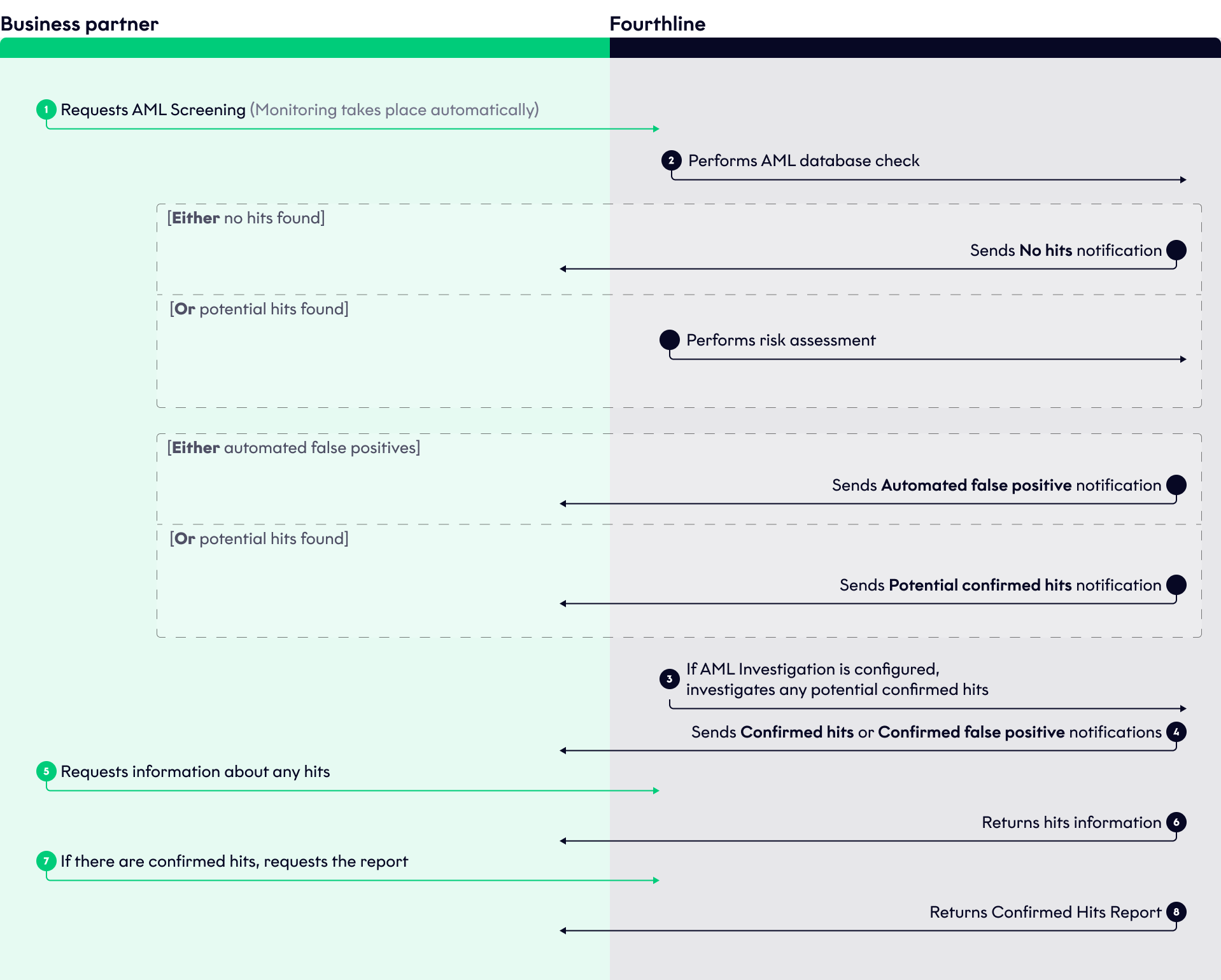
Fourthline performs a one-time screening to check whether the client appears in any public sanctions list, enforcement, PEP watchlist, or adverse media source.
You can request screening during onboarding or any time after.

AML database check
-
We screen all entries against the selected AML database using the following data points, where available:
Required data points
- First name
- Last name
- Gender
- Birth date
Recommended data points
- Address
- Age
- Geolocation (when used together with an Identity Verification flow)
- Nationality
- Place of birth
-
We notify you if no hits are found or if potential hits exist. For potential hits, we perform a risk assessment.
Name matching logic
To support accurate AML Screening where client data is limited, Fourthline provides configurable risk-based name matching logic.
When clients are screened against AML databases, names often don't match exactly due to:
- Different spellings of the same name (e.g., Mohammed vs Muhammad)
- Typographical errors or OCR errors
- Missing or extra spaces (e.g., JohnDow vs John Dow)
- Additional middle names or aliases
- Reversed name order (first and last name swapped)
Exact-match searches may fail to identify these records, increasing the risk of missed sanctions, PEP, or watchlist matches.
To address this, Fourthline applies fuzzy name matching - a risk-based matching approach designed to identify likely matches while limiting false positives.
Benefits
Fuzzy name matching:
-
Improves detection by identifying records with spelling variations or minor data errors.
-
Reduces false positives through controlled thresholds and supporting attribute checks.
-
Reflects real-world data quality, including aliases and transliteration differences.
-
Is configurable, allowing alignment with risk appetite and regulatory expectations.
-
Is explainable, with match reasoning included in the CDD report to support audits and regulatory review.
Support
To configure fuzzy name matching, contact your customer success manager.
Risk assessment
-
Fourthline's AI agent corrects any errors in the following data points, runs them through our proprietary risk model, and generates a risk score for each potential hit:
Required data points
- First name
- Last name
- Gender
- Birth date
Recommended data points
- Address
- Age
- Geolocation (when used together with an Identity Verification flow)
- Nationality
- Place of birth
Note
If only the required data points are provided, the resulting risk assessment score may be impacted. To ensure a more accurate and representative risk score, we strongly recommend providing both required and recommended data points.
-
If available, the address is validated via Google.
-
We check your configured auto-rejection threshold (e.g. 25 hits per case).
-
If screening is part of an Identity Verification flow, we also:
- Compare client-entered data to their identity document and correct any data entry errors.
- Check whether the client appears in your sensitivity list of known fraudsters or blocked individuals.
-
Our AI agent rules out false positives automatically.
If likely true matches remain and AML Investigation is enabled, we investigate further. -
Optionally, a second human agent can conduct a four-eyes review of confirmed hits.
Note
All Fourthline Identity Verification solutions include AML Screening and AML Investigation during case processing.
AML Monitoring
Fourthline performs checks every 24 hours to detect whether a client appears in any new or updated sanctions, enforcement, PEP, or adverse media entries.
Monitoring follows the same process as screening but focuses only on new and updated database records for efficiency.
AML Investigation
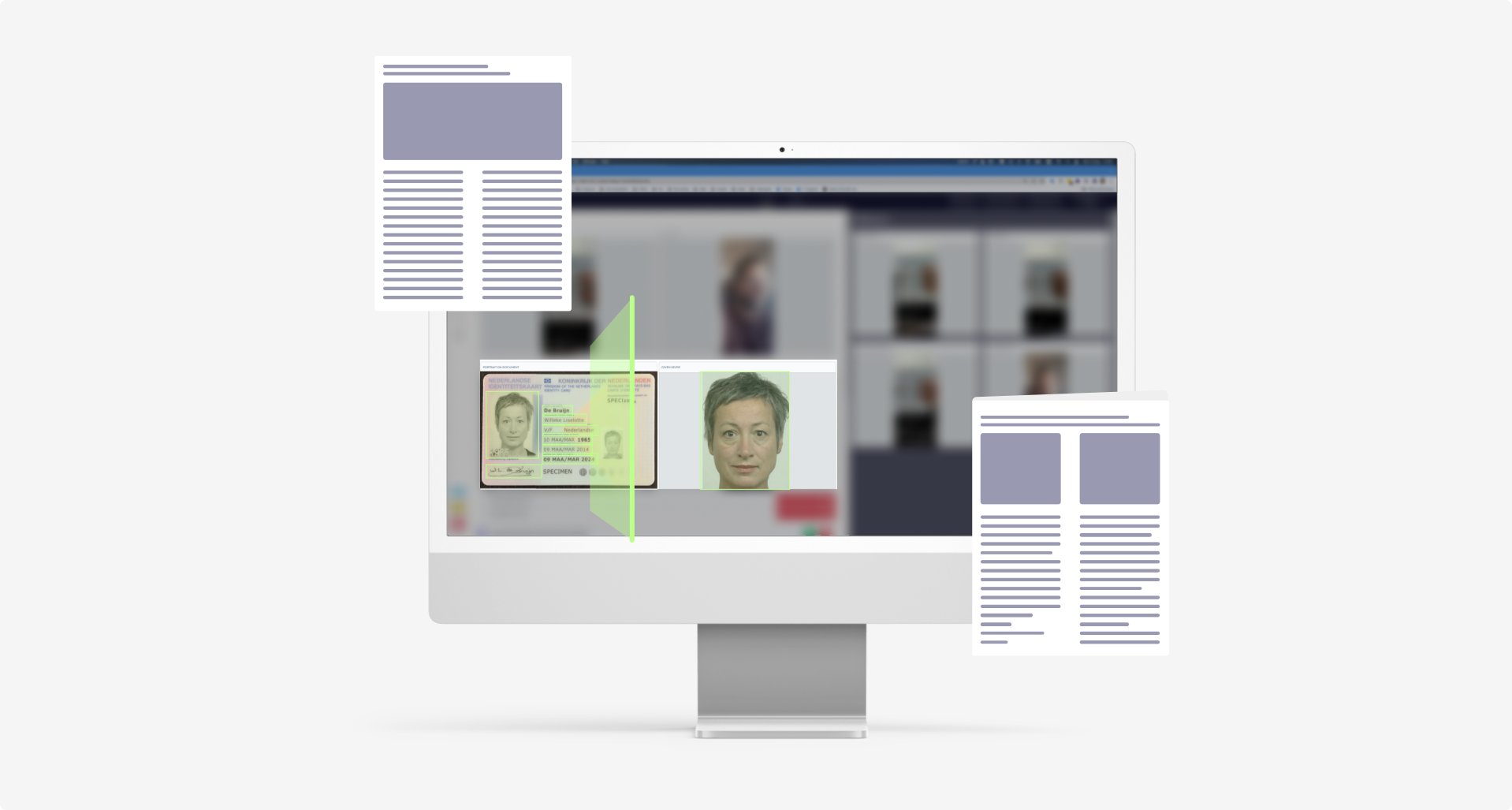
Fourthline’s AI and human agents perform a forensic OSINT investigation of potential hits (from AML Screening or Monitoring) to determine if they are true matches or false positives.
Without investigation, potential hits remain open and unconfirmed.
How investigation works
-
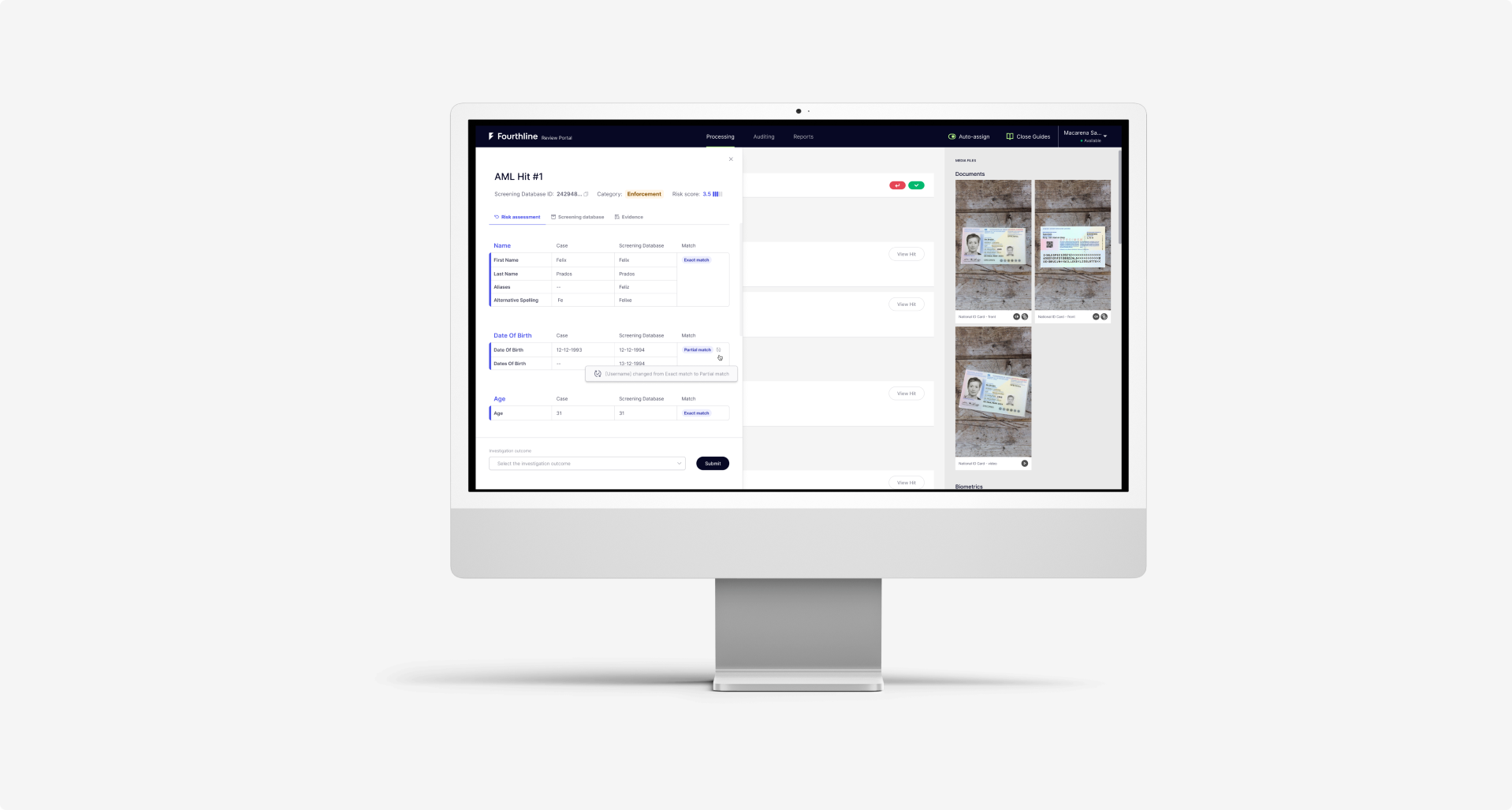
In the Case Review Portal, Fourthline’s AI compares corrected data points against your AML database:
Required data points
- First name
- Last name
- Gender
- Birth date
Recommended data points
- Address
- Age
- Geolocation (when used together with an Identity Verification flow)
- Nationality
- Place of birth
-
Each data point yields one of the following outcomes:
| Outcome | Description |
|---|---|
exact | Exact match found. |
partial | Partial match found. |
different-info | Match found with differing information. |
no-info | No match found. |
- Human investigators verify the potential hit using open-source and public data to confirm if the client is indeed the same individual.
Next steps
Learn how these products are used in Fourthline Identity Verification solution, or in standalone AML Solutions.
Updated about 2 months ago