
eID Verification
Product overview
eID Verification is Fourthline’s digital identification product for the German market, enabling secure onboarding through the German eID.
It delivers a high level of assurance in line with regulatory standards, including the eIDAS Regulation.
Because clients verify their identity with a trusted, government-issued credential, business partners benefit from higher conversion and reduced onboarding drop-off.
Overview
An eID is a secure, digital form of government-issued identification that enables an individual to prove their identity online or in digital services. It provides a level of assurance comparable to presenting a physical identity document in person and typically relies on cryptographic protections, secure chips, or authenticated identity wallets.
Under the eIDAS Regulation, each EU Member State can provide an official eID scheme recognized across the European Economic Area (EEA). This enables citizens to safely and seamlessly access digital public and private services, such as banking, healthcare, or identity verification, in any participating country.
To ensure strong authentication, an eID typically combines:
- An electronic identity document, mobile ID, or digital wallet (something the client has)
- A PIN (something the client knows)
For Germany, we offer the German eID Solution, which should be used alongside traditional identity verification methods.
About eIDAS
The eIDAS Regulation is an EU regulation (Regulation (EU) No 910/2014) that establishes the legal framework for electronic identification and trust services used in electronic transactions within the European Single Market.
Under eIDAS and eIDAS 2.0., banks must accept EU-notified eIDs and, going forward, the EUDI Wallet, as compliant forms of identification.
This ensures that KYC and re-KYC processes support high-assurance, cross-border digital identities and integrate qualified trust services such as electronic signatures and verified identity credentials.
This enables citizens to safely and seamlessly access digital public and private services, such as banking, healthcare, or identity verification, in any participating country.
German eID
The German eID enables clients to verify their identity securely using the electronic identification function of their identity document and a 6-digit PIN.
Supported documents
Fourthline’s German eID Verification product supports electronic identification using NFC-enabled German identity documents.
It currently supports the following document types:
| Document type | Description |
|---|---|
| New German national ID card (Neuer Personalausweis, nPA) | Personalausweis cards issued since 2010 are nPA cards, meaning they include an NFC chip and a 6-digit PIN for online identification (Online-Ausweisfunktion). The electronic ID function is enabled by default and allows secure authentication. |
| German electronic residence permit for non-EU citizens (Elektronischer Aufenthaltstitel) | Issued to non-EU nationals residing in Germany. It uses the same chip technology and security standards as the Personalausweis. The online identification function must be activated before use. Once activated, it uses the same 6-digit PIN and NFC verification process. Supported variants: AR, AS, and AF. |
| German eID card for EU citizens (Unionsbürgerkarte) | Issued to EU/EEA citizens living in Germany who are not German nationals. It provides eID functionality using the same technology as the nPA. It is optional. It is not an immigration residence permit — it is an eID credential for online identification. |
Support
Additional German electronic identity documents will be supported over time.
How it works
Objective
Enable electronic identification using the German national identity card (Personalausweis) and its integrated eID function, as well as other eID-enabled documents (such as residence permits and eID cards for EU/EEA citizens), to support secure online verification in compliance with § 18 Personalausweisgesetz - German Identity Card Act.
Process
The verification process follows these steps:
1. Consent confirmation
Before any personal data is shared, the client can review the list of identity attributes requested by Fourthline, and gives explicit consent to access the identity document and its data.
2. PIN entry
After giving consent, the client enters the 6-digit PIN of the ID card. Fourthline uses this PIN to securely unlock the eID data attributes stored on the card’s chip.
If the client only has a 5-digit Transport-PIN, they’re redirected to AusweisApp to set up their personal 6-digit PIN before continuing.
Support
Fourthline German eID supports:
- Handling incorrect 6-digit PIN errors.
- Unblocking a PIN using the Card Access Number (CAN). There is no limit on CAN entry attempts.
- Redirecting clients to AusweisApp to set up or manage their PIN.
Fourthline does not support PUK workflows. If a PUK is required, clients are redirected to AusweisApp or instructed to contact their local authority for assistance.
Click to magnify
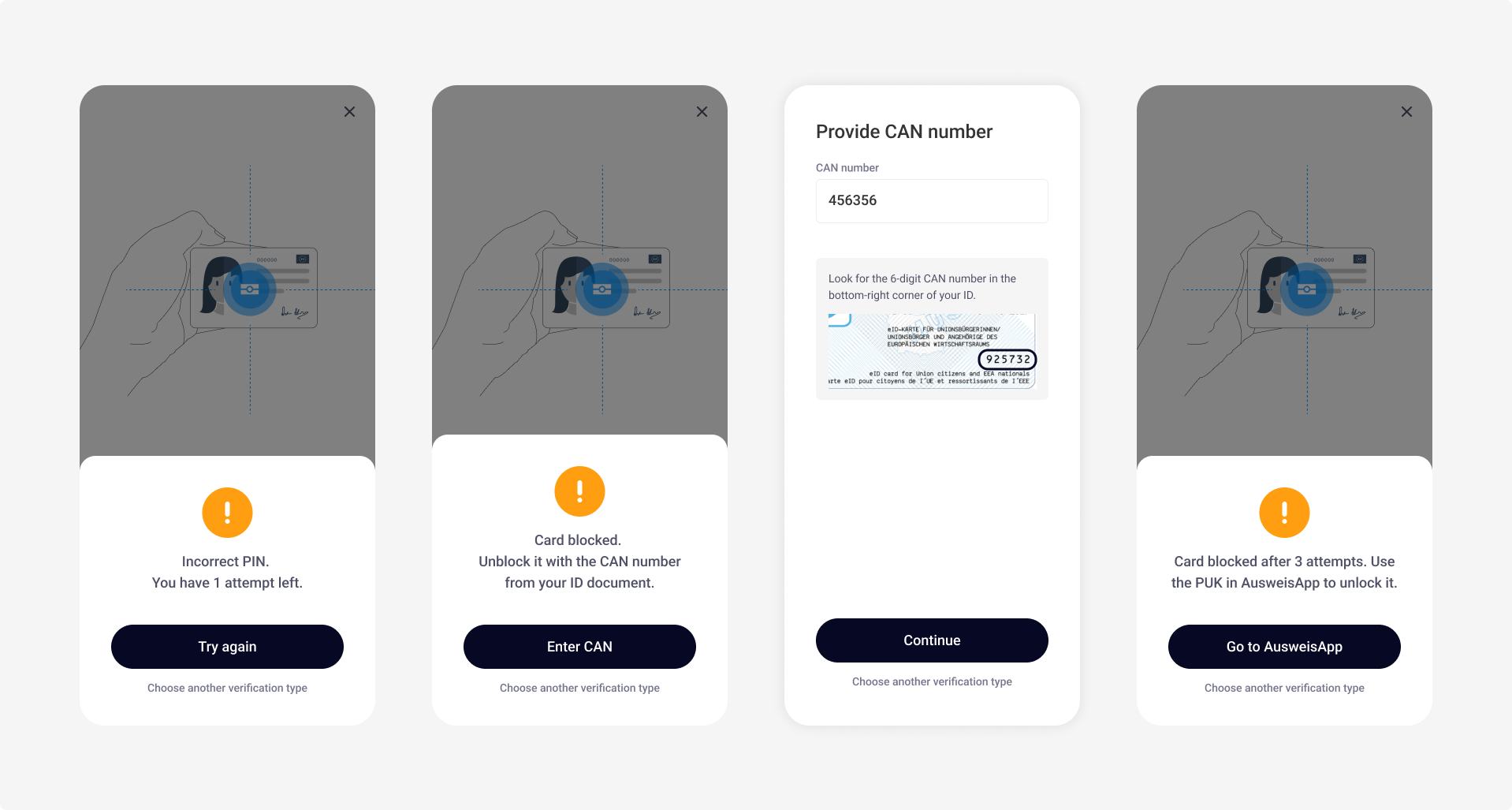
Unsuccessful PIN retry
3. Document NFC reading
The client holds their identity document against their mobile device to enable NFC reading via AusweisApp.
Using Document NFC, Fourthline reads the chip and completes the flow with either a successful verification or an error.
4. eID data attributes unlock
The verified data attributes are unlocked and processed by Fourthline’s backend for KYC and AML purposes.
5. Verification and completion
If the verification is successful, the client's identity is confirmed, and the onboarding process continues seamlessly. If errors occur (e.g., NFC failure, blocked PIN), the flow automatically redirects to a fallback verification path such the traditional German Solution.
Click to magnify
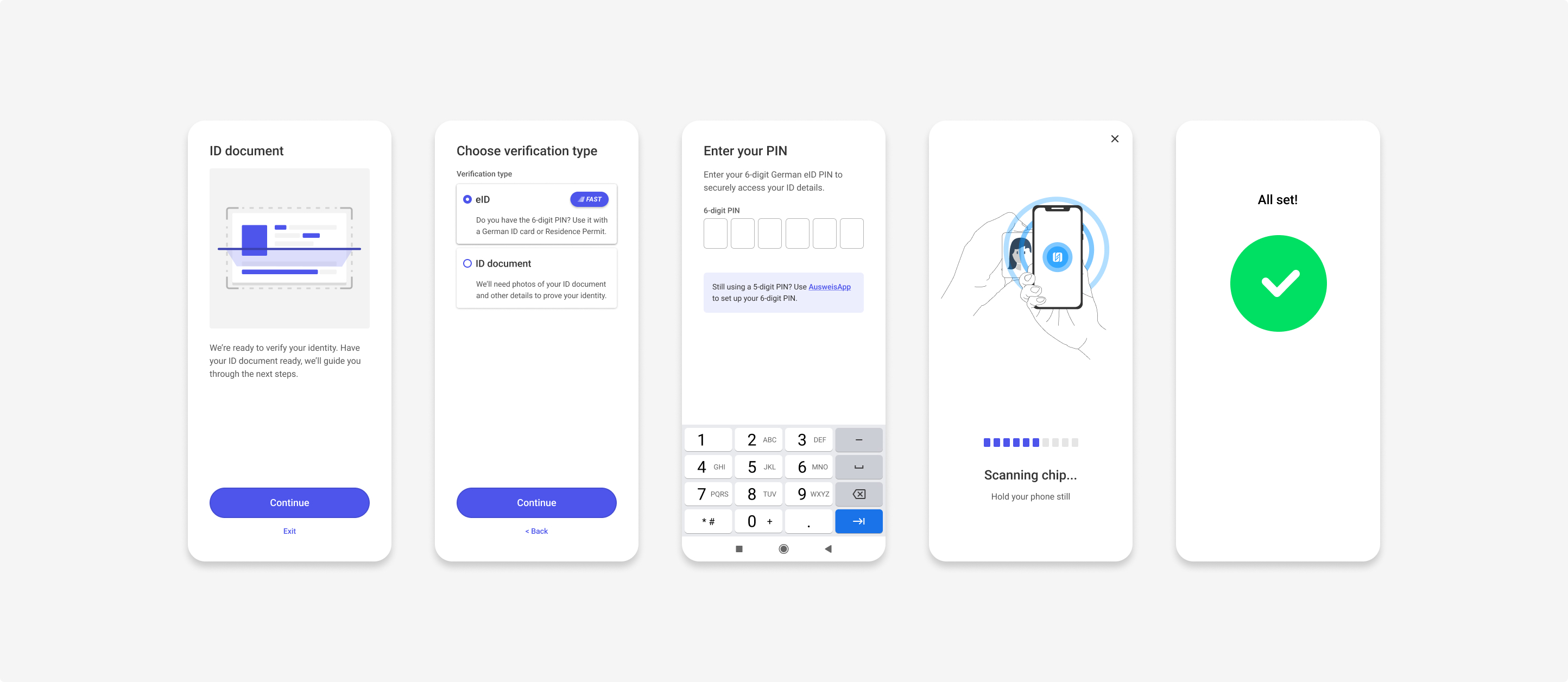
Successful German eID workflow
Verification check
Fourthline performs the following check:
| Check | Description |
|---|---|
| eID validity | Confirms the eID is valid and the data points can be read successfully. |
FAQs
What is the AusweisApp?
The AusweisApp is the official German ID card application that enables citizens to use the eID function on their ID cards for secure online authentication and data sharing.
Fourthline has integrated the AusweisApp SDK into its own SDK, combining the AusweisApp functionality with Fourthline’s UI and customization options for business partners. This ensures the client remains within the same branded experience rather than being redirected to an external app.
Fourthline is a German eID service provider. What does that mean?
As a German eID service provider, Fourthline is authorized to use the eID for secure customer authentication and data retrieval in digital services (e.g., banking, telecom, insurance, or eGovernment).
This authorization requires a certificate issued by D-Trust, the trust service provider of Bundesdruckerei, which acts as the central certificate authority for the German eID ecosystem.
In practice:
- Fourthline integrates the eID function into its workflows.
- Fourthline defines which data attributes (e.g., name, address, age) are accessed, following the data minimization principle.
- Fourthline holds official authorization from the Federal Office of Administration (BVA).
Is the German eID notified, and what level of assurance is it?
Notification means a Member State officially declares its eID system to the EU for mutual recognition.
The German eID is formally notified under eIDAS at the high assurance level. Germany notified the newer nPA with eID function to the European Commission in 2017. The Commission’s implementing decision confirmed that the German eID provides a high level of assurance under eIDAS.
What if I don't have access to an authentic German eID card for testing?
If you don't have access to an authentic German eID card for testing, contact your Fourthline delivery manager to arrange an alternative test approach.
Is Fourthline's German eID solution EAA (European Accessibility Act) compliant?
Yes. Fourthline’s German eID solution has been developed in accordance with EAA requirements.
For more details, see the Fourthline SDK Accessibility Statement.
What are the eID data attributes unlocked for the German eID?
The following verified identity attributes can be released when the client enters their PIN and consents to data sharing:
- Family name (Familienname)
- Optional: Name at birth (Geburtsname)
- Given names (Vornamen)
- Optional: Doctoral degree (Doktorgrad)
- Date of birth (Tag der Geburt)
- Place of birth (Ort der Geburt)
- Address (Anschrift)
- Nationality (Staatsangehörigkeit)
- Type of document (Dokumentenart)
- Expiry date (letzter Tag der Gültigkeitsdauer)
- Service- and card-specific identifier (dienste- und kartenspezifisches)
Why does the German eID not have a facial image in the NFC data attributes?
The German eID deliberately does not include a facial image in the NFC-accessible data attributes that service providers can read.
Can the client start the eID process but then switch to the Identity Verification workflow?
Yes. If a client starts the eID flow but encounters an issue (for example, a forgotten PIN), they can switch to the Identity Verification flow and complete verification using an IDVandQESandBAV workflow.
However, once a client starts the Identity Verification flow and reaches the ID document upload step, they cannot switch to the eID flow.
What happens if the client cannot proceed with German eID?
If the eID process fails because of certain errors (for example, a blocked PIN or missing authorization), the client is redirected to the IDVandQESandBAV workflow.
Does the German eID use passive, active, or chip authentication?
The German eID uses passive authentication and chip authentication, ensuring secure and verifiable data exchange with the ID card's chip.
Updated 22 days ago