
AML Screening & Monitoring Integration
Integration Guides
API-only guide
This guide provides step-by-step instructions on how to integrate AML Screening & Monitoring via our API.
Before you begin, make sure you have completed the required setup.
Flow
Click to magnify.
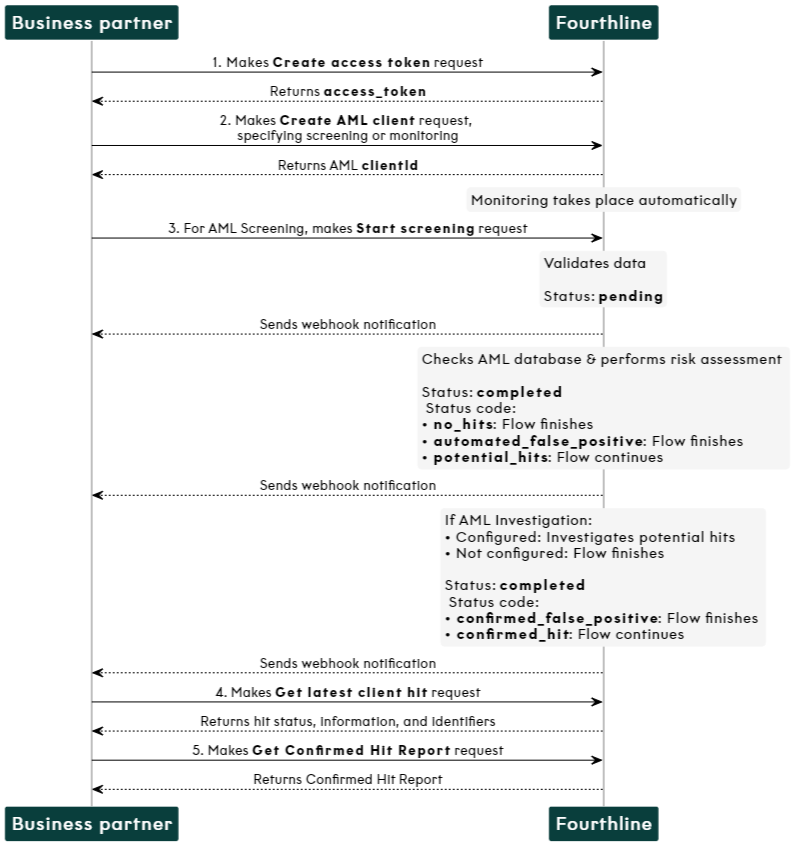
To integrate AML Screening & Monitoring via our API, follow these steps:
1. Authenticate
Create an access token to authenticate in our API:
- You provide your Fourthline API credentials.
- You receive an
access_token.
Tutorial: Create access tokenAPI Reference: Create access token
Important
For security, access tokens are valid for 1 hour only.
If your token expires, create a new access token by making another Create access token request.
2. Create client profile
Create a profile for the client:
- You provide your unique identifier for the client, their identity data, and specify screening or monitoring.
- You receive a Fourthline client
id.
Tutorial: Create AML client profileAPI Reference: Create AML client profile
Important
AML Monitoring starts automatically.
Monitor its progress using the monitoring statuses returned in the webhook notifications.
3. Start screening
 AML Screening only
Trigger the screening for one or multiple clients:
- You provide the
clientId(same value as theidreturned in the Create AML client profile response) for the client(s) you want to screen. - You receive the status of each client's screening.
Tutorial: Start one-time screeningAPI Reference: Start one-time screening
 Status: Check the screening status in the webhook notifications.
Client is already onboarded
If the client is already onboarded by Fourthline, to perform a single-time screening, follow these steps:
-
Make a POST Create AML client profile request using the same
ProviderClientIdas in the Identity Verification workflow. -
Set
MonitoringType=1to create an AML-specific client record linked to the existingclientId. -
Call Start one-time screening to initiate the screening.
4. Get hit information
If we find any hits, you can get information about them as required via the following API requests:
| Request | Description |
|---|---|
| Get latest client hit | Get the most recent hit for the client. |
| Get all client hits | Get all hits for the client. |
| Get investigation hits | Get all hits for a specific AML investigation. |
Possible hit outcomes include:
validating: There is a potential hit that hasn't (yet) been investigated.confirmed_hit: Our investigation confirmed the hit is definitely for this client.false_positive: Our investigation found that a potential hit wasn't for this client.
If we find a confirmed hit, get the investigation identifier needed to download the Confirmed Hit Report:
- You provide the
clientId(same value as theidreturned in the Create AML client profile response). - You receive information about the investigation and the identifier (
verificationId).
Tutorial: Get latest client hitAPI Reference: Get latest client hit
Note
Multiple investigations can be associated with a single AML
clientId.
5. Download the report
If there are any confirmed hits, download the
Confirmed Hit Report:
- You provide the investigation identifier (
verificationId). - A successful response is empty and the report is downloaded.
Tutorial: Get Confirmed Hit ReportAPI Reference: Get Confirmed Hit Report
Note
You can also download a CDD report using the Get CDD PDF request by passing the investigation identifier (
verificationId).
Updated 3 months ago